


Paraxylen
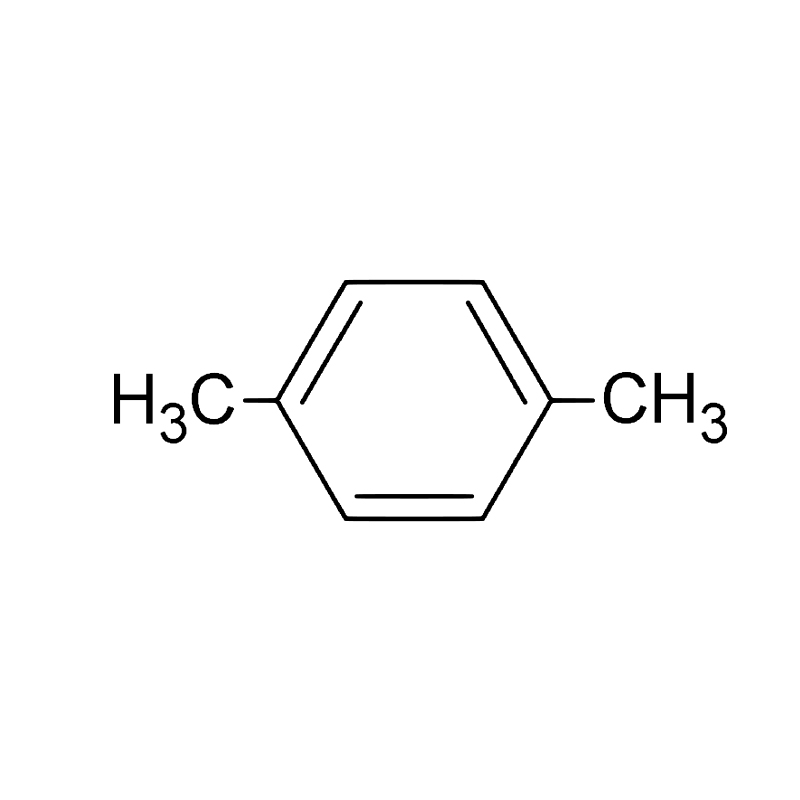
Para-xylene (p-Xylene) is an aromatic hydrocarbon and one of the three isomers of dimethylbenzene, commonly known as xylene. The “p-” prefix stands for “para,” indicating that the two methyl groups in p-xylene occupy the 1 and 4 positions on the benzene ring. This distinguishes it from the other isomers: o-xylene and m-xylene. All xylene isomers share the same chemical formula, C₆H₄(CH₃)₂. They are colorless, highly flammable liquids with a sweet smell. The odor threshold for p-xylene is 0.62 parts per million (ppm).
Production of Para-xylene
Catalytic Reforming:
Para-xylene is produced through catalytic reforming of petroleum naphtha, which is part of the aromatic fraction known as BTX (Benzene, Toluene, and Xylene isomers) extracted from catalytic reformate.
Separation Processes:
It is separated from m-xylene, o-xylene, and ethylbenzene through a series of processes such as distillation, adsorption, or crystallization.
Despite having the highest melting point among the isomers, purification of p-xylene is challenging due to eutectic mixture formation.
Cost Factors:
Separation methods are significant cost factors in p-xylene production, prompting ongoing research for alternative methods.
Natural Occurrence and Emissions:
p-Xylene naturally occurs in crude oil and coal tar. It is emitted from combustion sources, including automobile exhaust and tobacco smoke.
Applications of Para-xylene
Chemical Feedstock:
p-Xylene is a crucial raw material for synthesizing various polymers on a large scale. It is primarily used as a precursor in the production of industrial chemicals such as Terephthalic Acid (TPA), Purified Terephthalic Acid (PTA), and Dimethyl Terephthalate (DMT).
Polyethylene Terephthalate (PET) Production:
PET, a type of plastic made from TPA, PTA, and DMT, is widely used to manufacture bottles for water, carbonated beverages, and other drinks due to its lightweight, break resistance, and strength. PET also provides excellent carbon dioxide barrier properties, which help preserve carbonation in soft drinks.
Global Production and Demand
Demand Trends:
Due to its extensive applications, the annual demand for para-xylene reached 37 million tons in 2014 and continues to rise. This has led to significant industrial production levels.
Market Growth:
The global p-xylene market has experienced healthy growth, driven by strong demand from the textile and polyester fiber industries.
Environmental Concerns:
Renewable alternatives to petroleum-derived para-xylene are being explored to address environmental concerns.
Regional Production:
New para-xylene plants are mainly opening in the Asia-Pacific and Middle East regions to meet the growing PTA capacity.
Growth Projections:
The global p-xylene market is expected to grow at approximately 5% annually.
Properties of Para-xylene
Appearance and Odor:
Para-xylene is a clear liquid with a sweet odor. Its vapors are irritating, and it is less dense than water, making it insoluble in water.
Chemical Nature:
As an aromatic hydrocarbon (characterized by a benzene ring), para-xylene is one of the isomers of xylene where the two methyl groups are located opposite each other at positions 1 and 4 on the benzene ring. The chemical formula is C₈H₁₀.
Safety and Precautions
Health Hazards:
Skin Irritation: p-Xylene can cause skin irritation upon contact.
Ingestion: If swallowed, it can be fatal if it enters the airways.
Respiratory Irritation: p-Xylene may cause respiratory irritation.
Flammability:
Both the liquid and vapor forms of p-xylene are flammable.
Environmental Impact:
Para-xylene is harmful to aquatic life with long-lasting effects.
Safety Precautions
Personal Protective Equipment (PPE):
Wear appropriate laboratory clothing, gloves, goggles, and face shields when handling para-xylene.
In Case of Spillage:
Remove contaminated clothing immediately.
Exposure Response:
If inhaled, move the person to fresh air and contact a poison control center or physician immediately.
If ingested, rinse the mouth thoroughly and avoid inducing vomiting. Contact a poison control center immediately.
Storage:
Keep para-xylene away from heat, hot surfaces, sparks, open flames, and other ignition sources.